Grand Canyon: Packera multilobata and P. quercetorum Voucher Analysis
Table of Contents
Initial Analysis
Revised Analysis
Appendix 1: Further Discussion of S. stygius
Appendix 2: Discussion of four vouchers misdetermined as P. multilobata
Summary of Analysis Results
An analysis of vouchers of Packera multilobata from the Grand Canyon, and P. quercetorum from the Grand Canyon and from the Sedona area, shows that:
- True P. multilobata plants (ones that are similar to the type specimen of that species) have much narrower terminal leaf lobes than given in the floras. The measured values for plants at the Grand Canyon are just 4 to 9 mm, compared to the Flora of North America range of 10 to 30 mm! Measurements of a sample of five vouchers of P. multilobata from the Flagstaff / Prescott area give a similar range of 4 to 10 mm, and five vouchers from the Kanab to I-70 area give a range of 3 to 8 mm.
- The large range of terminal leaf lobe widths given in the floras for P. multilobata probably resulted from synonymizing Senecio stygius with P. multilobata. This appears to be incorrect, since the type specimen of S. stygius has measurements of the leaf terminal lobe, the leaf rosette width, and stem height that are almost exactly those of the P. quercetorum type specimen. Therefore S. stygius should have been synonymized with P. quercetorum.
- The error in synonymy possibly resulted from a number of the Grand Canyon plants of P. quercetorum (except for the S. stygius type specimen!) having systematically somewhat-smaller measurements compared to plants of P. quercetorum from elsewhere.
- At the Grand Canyon, P. multilobata lives almost entirely on the North and South Rims at elevations of 6000 to 8100 feet, with a small number of plants growing just below the Rims at slightly-lower elevations. This is similar to its elevation range in the Flagstaff / Prescott area of ~5000 to 8000 feet, and in the Kanab to I-70 area of 5000 to 10,000 feet.
- At the Grand Canyon, P. quercetorum lives almost entirely in the Canyon at elevations of 2000 to 4000 feet. This is a bit lower than its elevation range in the Flagstaff / Prescott area of 3000 to 6000 feet.
Initial Analysis
After making the plot of the terminal lobe width vs. rosette width for mostly-non-flowering rosettes of Packera multilobata plants on the South Rim, as part of my page on P. multilobata and P. quercetorum, I was curious about how well flowering plants of both P. multilobata and P. quercetorum would fit their expected location in that plot from the values in the Flora of North America. It occurred to me that I could use the wonderful photos of vouchers to fill in the plot with flowering specimens.
That worked well! It was an easy task to whip through the vouchers with images to measure the terminal lobe widths, leaf lengths, and stem heights.
There were 22 photographed vouchers of P. multilobata in the main corridor of the Grand Canyon from Marble Canyon to Hermits Rest retrieved by SEINet, of which only one didn't have basal leaves present, leaving 21 vouchers I could measure. There were also three photographed vouchers of P. quercetorum from that same area. I also measured the type specimen of Senecio stygius, now synonymized with P. multilobata, collected from the Grand Canyon, and a specimen of Senecio multilobatus from its type locality of the Uintah River Basin in northeast Utah. I picked an imaged voucher at random from the type locality for S. multilobatus since I couldn't find an image of the type specimen.

All these Packera species were originally placed in Senecio, so the names of the type specimens are all Senecio, but they are synonyms. I.e., Packera multilobata is a synonym of Senecio multilobatus, and P. quercetorum is a synonym of S. quercetorum.
To get more data for P. quercetorum, I also retrieved 13 photographed vouchers of that species from the Sedona / Oak Creek area, which includes its type locality. Two had no basal leaves present in the voucher, and one had no scale, leaving ten vouchers I could measure. I also measured the type specimen for Senecio quercetorum.
Fig. 1 shows the measurements from vouchers of the leaf terminal lobe width plotted vs. rosette width at top, accompanied by the plot of my measurements of plants on the South Rim at bottom, updated to have the same scale and same colors, for comparison. I defined the rosette width of vouchers to be twice the length of the largest lowermost leaf seen in the image. The plots also show rectangles that delimit the range in values of those characteristics from the Flora of North America (FNA).


Fig. 1. Top: Plot of leaf terminal lobe width plotted vs. rosette width from measured vouchers. The rosette width is twice the length of the largest basal leaf seen in the image. The rectangles delimit the range of values of those characteristics from the Flora of North America (FNA). GC = Grand Canyon.
Bottom: Same plot for field measurements of plants that just had leaf rosettes, that I measured on the South Rim in mid-September 2026.
The top plot in Fig. 1 is a little busy due to the inclusion of the type specimens, but it was important to have the type specimens on the plot to see which vouchers agreed with the type specimens. The type specimens are represented by large asterisks.
The measurements on the type specimen for P. quercetorum agree well with the measurements on vouchers determined as that species. All but two of the P. quercetorum measurements fall within the range given in the FNA. Two of them are slightly larger for both measurements, which is not surprising since it is almost always the case that floras don't report the full ranges for most characteristics. Most botanists don't measure a large number of vouchers for most characteristics, and floras just give rounded values for most characteristics, such as the 20 to 50 mm range for the leaf lobe widths for P. quercetorum.
What is most surprising is that the measurements for the type specimen of S. stygius from the Grand Canyon agree closely with those for the type specimen of S. quercetorum! The FNA synonymizes S. stygius with P. multilobata, not P. quercetorum. Discussion of why they might have made that choice is given in Appendix 1.
The stem height measurements on those type specimens, shown in Fig. 2, also have close agreement. Those three measurements strongly imply that S. stygius should be synonymized with P. quercetorum.
The measurements on the type specimen for P. multilobata agree well with the large cluster of the voucher measurements for that species for the width of the terminal lobe. The type specimen is a bit small for the rosette width compared to that large cluster, but that is likely due to the lack of basal leaves on that voucher, so the measurement was on the lowest cauline leaf.
That large cluster of measurements for P. multilobata contains 17 vouchers. Four other voucher specimens determined as P. multilobata fall outside that cluster, and at least two of them, and probably the other two as well, are misdetermined P. quercetorum plants. All four are discussed individually in Appendix 2.
The measured widths of the terminal lobe in that cluster agree poorly with the FNA ranges. The measured values for those 17 vouchers are 4 to 9 mm, compared to the FNA range of 10 to 30 mm! The measured values for the rosettes I studied in the field are also at the lower end of that range, 9 to 17 mm. If the vouchers were consistently missing the larger basal leaves because they had shriveled, that might account for the very small measured lobe widths. But if so, that didn't happen for P. quercetorum voucher measurements. And since the FNA values were presumably derived from measurements of vouchers, this seems a bit puzzling until one remembers that plants formerly called S. stygius were included within P. multilobata in the FNA. Further discussion of that is given in Appendix 1.
Fig. 2 shows the lobe width (same as in Fig. 1) plotted vs. stem height.

Fig. 2. Plot of leaf terminal lobe width plotted vs. flowering stem height from measured vouchers.
Note that overall good separation in the stem heights between the two species, with minimal overlap. The smallest P. quercetorum stem is an anomaly, a very weak probably not fully developed stem on the voucher.

Revised Analysis
Figs. 3 and 4 show revised plots of the three measured characteristics on the vouchers, after redetermining the four vouchers discussed in Appendix 2 as P. quercetorum.

Fig. 3. Revised plot of leaf terminal lobe width plotted vs. rosette width from measured vouchers, after redetermining four vouchers.

Fig. 4. Revised plot of leaf terminal lobe width plotted vs. flowering stem height from measured vouchers, after redetermining four vouchers.
The plots look beautiful now! Not only do they show excellent separation between the two species, they show how well defined P. multilobata is for the width of its terminal leaf lobe.
The consistency of its narrow terminal leaf lobes appears to be true in other areas, too. I checked five vouchers each in two separate areas, the Flagstaff / Prescott area, finding widths of 4 to 10 mm, and the Kanab to I-70 area, measuring widths of 3 to 8 mm. Both are very consistent with the 4 to 9 mm of the Grand Canyon plants that are truly P. multilobata.
The elevations of the species now separate quite well at the Grand Canyon. In photographed vouchers, P. multilobata is found only on the Rims of the Grand Canyon, in a narrow range of 6000 to 8100 feet, except for a single voucher, consistent with the lower elevation reported in Kearney and Peebles of 6000 feet. That single voucher was said to be taken from 3820 feet elevation, but its location is within a mile of an edge of the North Rim at 6000 feet, and may be a population that was established from the nearby North Rim. There are iNaturalist observations of P. multilobata plants growing slightly below the Rim on the South Kaibab and Hermit / Dripping Springs Trail, so a small number of plants grow just below the Rims at somewhat lower elevations than 6000 feet. There may also be non-photographed vouchers of plants just below the Rims.
P. quercetorum vouchers are from 2000 to 4000 feet elevation, with the exception of what was probably a waif found in the Ten X Campground at 6650 feet.
The separation in elevation discussed above was for photographed vouchers that I could examine. I also made a histogram of the voucher elevations for both species from all vouchers, which includes misdetermined vouchers, shown in Fig. 5, which supports the conclusions from photographed vouchers.
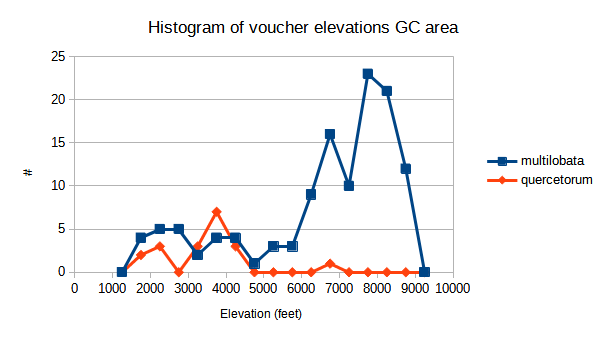
Fig. 5. Histogram of elevations for all vouchers of P. multilobata and P. quercetorum for the Grand Canyon area, which include some misdetermined vouchers.
The elevations of all vouchers of P. multilobata from the Grand Canyon area show a clear peak from 6000 to 9000 feet.
The elevations of all vouchers of P. quercetorum range from 2000 to 4500 feet, with only the single probable-waif voucher from the Ten X Campground at 6650 feet.
It is highly likely that most of the vouchers determined as "P. multilobata" from below ~4500 feet are actually vouchers of P. quercetorum, since their elevation histogram matches that of P. quercetorum fairly well.
I also made histograms of the voucher elevations of both P. multilobata and P. quercetorum in the Flagstaff / Prescott area, and of just P. multilobata in the Kanab to I-70 area (P. quercetorum doesn't grow there), shown in Figs. 6 and 7.
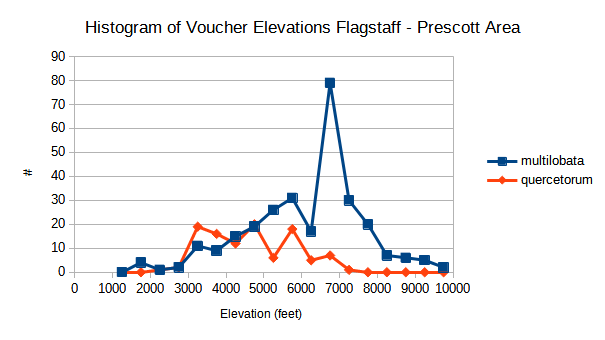
Fig. 6. Histogram of elevations for all P. multilobata and P. quercetorum vouchers for the Flagstaff / Prescott area.
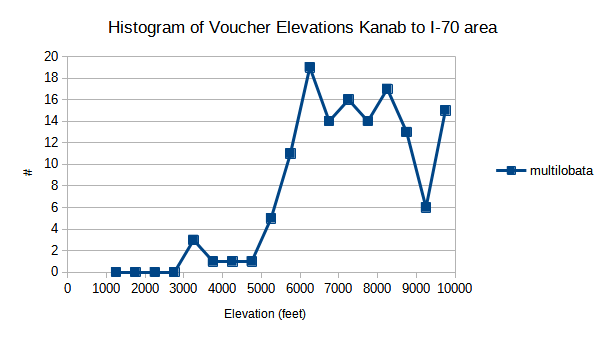
Fig. 7. Histogram of elevations for all vouchers of P. multilobata for the Kanab to I-70 area.
In the Flagstaff / Prescott area, most vouchers of P. multilobata are found from ~5000 to 8000 feet. In the Kanab to I-70 area, almost all vouchers of P. multilobata are from 5000 to 10,000 feet.
In the Flagstaff / Prescott area, most vouchers of P. quercetorum are found from 3000 to 6000 feet.
These elevation ranges are quite consistent with the elevation ranges deduced for these two species in the Grand Canyon, after redetermining those four vouchers.
From these results, it is possible that the vouchers from below 5000 feet determined as "P. multilobata" in the Flagstaff / Prescott area are misdetermined.
Appendix 1: Further Discussion of S. stygius
Greene described both S. quercetorum and S. stygius in the same issue of his Leaflets of botanical observation and criticism in 1909 (see his description of S. quercetorum and on the next page that of S. stygius), but he did not directly state the distinction between them. There were no basal leaves on the type specimen for S. stygius, but he described the cauline leaves for both similarly, "lyrate-pinnatifid" for S. quercetorum and "lyrate-pinnate" for S. stygius. The main difference in his description is "perennial" for S. quercetorum, and "annual or biennial" for S. stygius.
The measurements on three P. quercetorum vouchers from the Grand Canyon vouchers fall at the very low end of the FNA numbers for that species for all three measurements of the terminal lobe width, rosette width, and stem height. However, the measurements on the type specimen of S. stygius from the Grand Canyon are at or above the mid-range of the FNA numbers for P. quercetorum, and the measurements on a voucher taken at mile 148 (see below) also fall in the middle to high end of the FNA numbers. Hence the low values for the three vouchers could simply be due to chance. Alternatively, it may imply that the Grand Canyon plants of this species are somewhat different on average from the ones closer to the center of its range. The FNA says that P. quercetorum is only known from "relatively small populations in central and southern Arizona and west-central New Mexico", so the small number of Grand Canyon plants of this species are geographic outliers which are often slightly different from the main population of a species.
My speculation about why the FNA authors synonymized S. stygius with P. multilobata and not P. quercetorum is as follows:
The Grand Canyon plants were originally all called S. stygius, and considered separate from P. quercetorum in range. Kearney and Peebles placed P. quercetorum only south of the Grand Canyon. Note the comment on the mile 148 voucher that "the stygius phase [of P. multilobata] which may approach S. quercetorum". That comment describes perfectly those three vouchers from the Grand Canyon now determined as P. quercetorum, since, as mentioned above, they fall in the lower end of the range in measurements of P. quercetorum. However, it doesn't describe the mile 148 voucher very well since that voucher is in the middle of the range for the terminal lobe width, and has the largest rosette length of any of my P. quercetorum vouchers. But except for that voucher, and the voucher of the type specimen of S. stygius, there are six tightly clustered measurements in Fig. 1 that could well be considered representatives of a single taxon of S. stygius: the three vouchers now determined as P. quercetorum from the Grand Canyon, and three of the four vouchers now determined as P. multilobatus from the Grand Canyon, discussed in Appendix 2.However, if one decides not to accept S. stygius as a separate species, you have to shove these plants into either P. multilobata or P. quercetorum, and the experts decided to shove them into P. multilobata. That nicely accounts as well for the range in values for the leaf terminal lobe width reported in the FNA.
The experts must have made that choice before they saw the voucher from mile 148, since that voucher clearly implies that S. stygius should have been lumped into P. quercetorum. They may have also thought that the type specimen for S. stygius was anomalous.
Remember, the above is speculation; I don't know for sure their reasons behind the lumping of S. stygius with P. multilobata.
Appendix 2: Discussion of four vouchers misdetermined as P. multilobata
Two of these vouchers fall in the P. quercetorum part of the plot in Fig. 1, and are almost surely misdetermined vouchers. Both of those vouchers were taken from along the Colorado River in the bottom of the Canyon, one from mile 116.5, and the other from mile 148. The leaves of both of those vouchers look much more like the leaves of P. quercetorum than the leaves of P. multilobata. The elevations of those plants are 2100 and 2000 feet, respectively, far below the typical elevations of 6000 to 7000 feet of P. multilobata in the Grand Canyon, and even somewhat lower than the lowest elevation given for P. quercetorum in the FNA and in Kearney and Peebles.
However, the mile 148 voucher was annotated twice by Packera experts. It was first annotated as Senecio multilobatus (the older name for P. multilobata) in 1980; then annotated as S. quercetorum in 1984. It was then annotated back to S. multilobatus in 1985 by Craig C. Freeman, a Packera expert, with the comment "representative of the stygius phase which may approach S. quercetorum". The final annotation was by Debra Trock, the FNA author of the Packera treatment, in 2004, also as P. multilobata.
See Appendix 1 for speculation as to why this voucher was called P. multilobata.
The mile 116.5 voucher was never annotated by an expert.
The determinations of the other two "P. multilobata" vouchers with outlying measurements from the 17 vouchers with leaf terminal lobes less than 10 mm are less clear. Their leaf terminal lobe widths and rosette widths are consistent with the FNA values for P. multilobata. However, their stem lengths are almost dead between the maximum stem length for P. multilobata in the FNA values, and the minimum stem length for P. quercetorum in the FNA values. Both vouchers are from in the Canyon, one at 3900 feet and the other at 4400 feet, which argues for a P. quercetorum determination. The 3900 foot voucher has basal leaves that look like those of P. quercetorum. Given that it plots close to the three Grand Canyon vouchers determined as P. quercetorum also argues for that id.
The determination history of the voucher at 4400 feet is also interesting. Glenn Rink originally determined it as S. quercetorum in 2007. Then in 2022, Glenn Rink and Max Licher redetermined it as P. multilobata. The lowermost leaves on the voucher are missing their terminal lobes, so some key information is missing from that voucher. Some of the other leaves look like the leaves of P. quercetorum, but some look like the leaves of P. multilobata. No wonder the determination of that voucher is less than clear.
However, given that all four of these vouchers were taken from in the Canyon, at elevations of 2000, 2100, 3900, and 4000 feet, typical of elevations for P. quercetorum, and much lower elevations than the typical 6000 to 8100 feet of vouchers of P. multilobata, it is highly likely that all four of those vouchers are actually P. quercetorum.
Analysis of P. multilobata plants from two other areas, the Flagstaff / Prescott area, and the Kanab to I-70 area, confirmed that true P. multilobata plants have very narrow terminal lobe widths just like the Grand Canyon plants in the tight cluster. The widths were 4 to 10 mm in the Flagstaff / Prescott area; 3 to 8 mm in the Kanab to I-70 area, and 4 to 9 mm in the Grand Canyon area.
Acknowledgments
This study would not have been possible without all the wonderful people who have collected vouchers from the areas I study, the herbaria that house them, digitize their collecting information, and photograph the vouchers, as well as all the experts who have annotated these vouchers and studied them to produce descriptions in floras. The wonderful website of SEINet made it easy to get the voucher information and photos of the voucher.
The studied vouchers were retrieved from SEINet at various times in the first week of October 2026.