Packera multilobata on the South Rim area of the Grand Canyon, and Comparison to P. quercetorum
| Packera multilobata | P. quercetorum | |
| 
| |
| 
| |
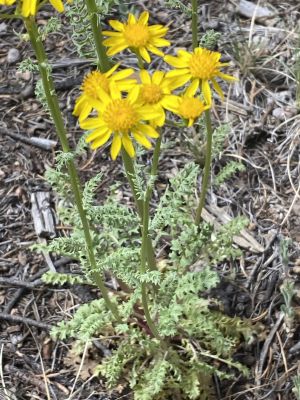
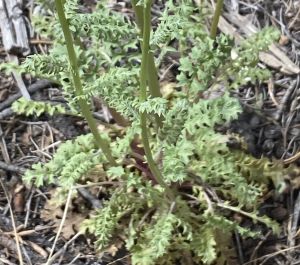
| Fig. 1. Left: photos of Packera multilobata from the South Rim of the Grand Canyon, from the Desert View Drive between Moran Point and Navajo Point, by iNat user @pstr. Right: photos of P. quercetorum from Oak Creek Canyon northeast of Sedona, by Max Licher. Top: photos of entire flowering plant. Bottom: photos of basal leaves.
P. quercetorum is generally a larger plant than P. multilobata, requiring a photo from farther away to show the entire flowering plant (flowers down to basal leaves), as shown in the top row of photos. As befits its name, P. multilobata usually has many small lobes on its basal leaves, as shown in the bottom left photo, whereas P. quercetorum has a large terminal lobe on its basal leaves, as shown in the bottom right photo. Click on the pictures to go to the original iNat obs. | ||
While reviewing the iNat observations downloaded in 2025 of species from the South Rim of the Grand Canyon, for possible additions to the flora of the South Rim, I came across three observations determined as P. neomexicana, and a single observation determined as P. quercetorum, both of which were not in the South Rim Flora. Two of the three observations determined as P. neomexicana were actually of Penstemons, and the third was a seedling with just three leaves that was too young to positively identify. But the single observation determined as P. quercetorum looked like it could be that species, and was from one of the surveys I did with Don Rideout, so I knew it had an accurate location.
P. quercetorum is a larger plant than P. multilobata, with flowering stems usually two to three feet tall (60 to 100+ cm), compared to the eight to sixteen inches tall (0.7 to 1.3 feet; 20 to 40+ cm) flowering stems of P. multilobata. The rosette leaves of P. quercetorum for flowering plants have terminal lobes larger than the lateral lobes, whereas the rosette leaves of P. multilobata for flowering plants have terminal lobes smaller than the lateral lobes. See Fig. 1 for both of these characteristics.
Note that this description, as is true for most descriptions in floras, is based on vouchered flowering plants, which thus have mature leaves. It may or may not be correct to use this distinction for young rosette leaves which may have different shapes. The first leaves of young plants are not always the same as their mature leaf shapes. For example, plants with lobed leaves often produce unlobed leaves at first to capture more sunlight. See, for example, this pix of a Cirsium vulgare leaf going from non-lobed first leaves to many-lobed later leaves.
P. quercetorum is in the Grand Canyon Flora, but was given as occurring from 1600 to 3500 feet in the Canyon, far below the lowest elevation of the South Rim of about 6800 feet. There are no vouchers of that species from the South Rim, but there is a single voucher that is from just south of the Park border, in the Ten X campground two miles south of the southern Park entrance, that appears to be correctly determined, from its 2.2 foot (67 cm) stem length, and the large terminal lobes on its basal leaves. That voucher might have been a waif from a camper, since there are no other vouchers in that area, and the ~6600 foot elevation of that campground is unusually high for that species. The Arizona Flora by Kearney and Peebles gives P. quercetorum as occurring from 3500 to 6000 feet elevation, "chiefly in the Oak Belt".
In contrast, there are 39 vouchers of P. multilobata from the South Rim area.
To try to understand if there were plants of P. quercetorum in the South Rim Area, in summer 2026 I reviewed all the iNat Packera observations from there. Among the observations that showed enough of the plant for a reliable determination, there were 82 iNat obs that were clearly P. multilobata, with only P. multilobata leaves and/or the short inflorescence of that species, and no obs at all that were definitively P. quercetorum. Most of those iNat observations had an inflorescence.
Even though few of the iNat observations have a scale in their photos, as mentioned in the Fig. 1 caption and shown in the photos there, it is often possible to tell whether a flowering stem is taller than two feet or not if there is a photo of the plant from the side. Shorter stems can be seen in focus in a single photo, whereas taller stems require either a photo from a large distance, or require separate photos to show the entire stem.
I found four other rosettes with leaves similar to the single observation linked above that could possibly be P. quercetorum.
To see if the species could reliably be distinguished in rosette form, without an inflorescence, I put all the South Rim Packera rosette-only iNat plants on a webpage side by side by P. quercetorum rosettes from its type locality in the Sedona area.
I concluded that it was not possible to determine young rosettes definitively because the first leaves of seedlings of P. multilobata apparently have no or few lobes, with a terminal lobe much bigger than the other lobes, making them look like the leaves of P. quercetorum. Later leaves become normal leaves for P. multilobata with many lateral lobes, and the terminal lobe becomes much less prominent than the terminal lobe of P. quercetorum. A good example showing the transition in leaf shapes is in fact the single observation determined as P. quercetorum mentioned above. The youngest leaves, which are the outermost leaves nearest the ground, have a large terminal lobe similar to that of P. quercetorum. But the innermost leaves are getting closer and closer to normal P. multilobata leaves, which never happens in true P. quercetorum plants.
As part of my Grand Canyon trip in mid-September 2026, I followed up seven of the iNat observations showing only rosettes to see if any had flowering stems present that could give their proper determination, or had different more-mature basal leaves. Somewhat surprisingly to me, I was able to relocate only a single plant, the seedling with just three leaves mentioned above, which had been observed on 11 November 2024, 1.8 years before my follow-up visit. My follow-up observation found two young plants at that same location, with similar older leaves to the original observation. However, given the uncertainty of the original location, it isn't certain that this is the same plant.
Of the other six iNat observations I tried to follow up, two observed in 2022 and 2024 had a number of P. multilobata plants within several hundred feet of the iNat locations; two observed in 2022 and 2024 had no Packera plants at all in their vicinity; and two observed in 2025 and 2026 had a location that was 50 feet west of the Rim in an area that had no trail and was too steep for me to get to, with no Packera plants visible nearby.
I also drove through part of the Ten X campground south of Tusayan to look for Packera plants near that voucher location, but only found a single plant of Senecio flaccidus.
Although this was disappointing, I found and measured enough other Packera rosettes to conclude from the size of the plants that all these plants were P. multilobata, even the ones that looked like P. quercetorum from the shape of their leaves.
I placed rulers next to 16 separate rosettes, and put a tape measure against the stem of a 17th plant which still had measurable basal leaf lengths.
At home, from the photographs, I measured the full width of the rosette, and the min and max terminal lobe widths. I also classified them as "P. multilobata" (11 plants), if they clearly had the multiple lobes of that species, or "??" (5 plants) if they didn't.
Fig. 2 shows the results in a plot of the terminal lobe width vs. the rosette full width.
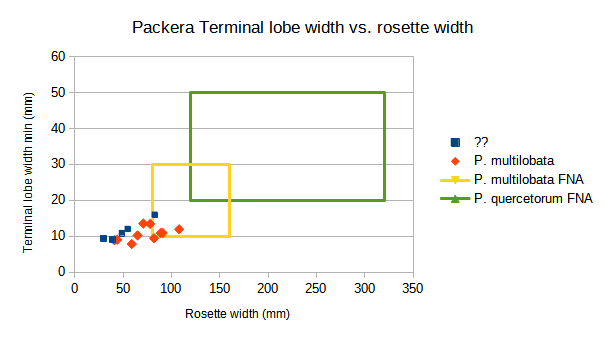
Fig. 2. Plot of the terminal lobe width vs. the rosette full width for Grand Canyon South Rim Packera plants measured in September 2026. The plot also shows the ranges for those characteristics given in the Flora of North America treatments for those two species.
Note that four of the five plants I classified as "??" were among the smallest rosettes, and therefore presumably the youngest plants. That suggests that, as I suspected, the plants I classified as "??" are just young plants of P. multilobata that don't have the usual number of lobes that older plants do, and can't be easily discriminated from P. quercetorum except if there is a scale in the pix. The fifth plant classified as "??" was the only one growing below the Rim, and it had another Packera rosette growing within its rosette. Both of those may have influenced its development.
I also put in the plot the ranges given in the Flora of North America for both species, which are almost surely derived from flowering plants. Non-flowering plants would be expected to have somewhat-smaller leaves. The results clearly indicate that these plants are P. multilobata and not P. quercetorum. If any plants had actually been P. quercetorum, some should have plotted within the green rectangle.
It would be wonderful if someone can photograph some rosettes of P. quercetorum from the Sedona / Oak Creek Area with a scale in the pictures, to see where they plot in Fig. 2.
I was curious as to how well flowering plants of both P. multilobata and P. quercetorum would fit their expected location in that plot from the values in the Flora of North America. It occurred to me that I could use the wonderful photos of vouchers to fill in the plot with flowering specimens.
That worked well! See Grand Canyon: Packera multilobata and P. quercetorum Voucher Analysis.
Fig. 3 shows the rosettes that were measured for Fig. 2, in order of size, from smallest to largest rosette, which presumably is in order of age. All the pictures are to the same scale, so as you scan down the images, you are presumably watching how the plants grow. It is apparent in Fig. 3 how the leaves change shape as the rosette grows.
The measurements for each plant are also given in Fig. 3, along with a plant number for easy reference, and sometimes some comments. The plant number is simply the order in which I photographed the plants. It actually refers to the photo number, so the two plants seen in Photo #4 are labeled "4(top)" and "4(bottom)".

Rosette width 30 mm; terminal lobe widths 8.0 to 10.7 mm. Plant #9, found in a large field of Packera rosettes along the Rim Trail north of the Old Visitor Center Area, now the Park Headquarters. | 
Rosette width 39 mm; terminal leaf lobe widths 8.7 to 9.4 mm. Plant #8, found in a large field of Packera rosettes along the Rim Trail north of the Old Visitor Center Area, now the Park Headquarters. Also note the very young plant at top of this photo. |
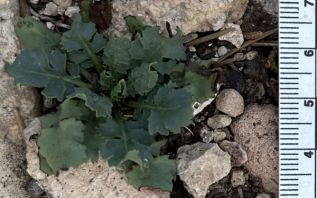
Rosette width 41 mm; terminal leaf lobe widths 8.2 to 9.6 mm. Plant #5 from the Rim Trail west of Yavapai Point. | 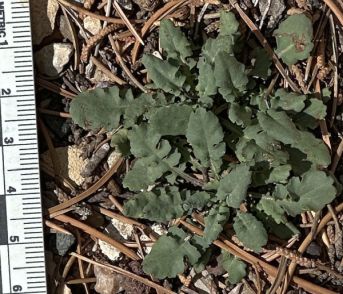
Rosette width 44 mm; terminal leaf lobe widths 8.4 to 9.7 mm. I think there are three plants growing together here. The measurements are for the lowermost one. Plant #1 from the Rim Trail west of Yavapai Point. |

Rosette width 49 mm; terminal lobe width 9.5 to 12.2 mm. Plant #17 from the area along the Rim Trail north of the Old Visitor Center, now the Park Headquarters. | 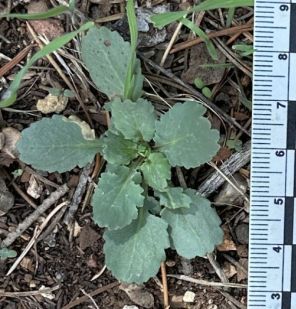
Rosette width 55 mm; terminal lobe width 9.5 to 14.5 mm. Plant #18 from the area along the Rim Trail north of the Old Visitor Center, now the Park Headquarters. |

Rosette width of 59 mm, and terminal leaf lobe widths of 7.3 to 8.4 mm. Plant #4(top) from the area along the Rim Trail west of Yavapai Point. | 
Rosette width 61 mm; terminal lobe width 9.1 to 13 mm. Plant #22, from the flat area in the first part of the New Hance Trail. |
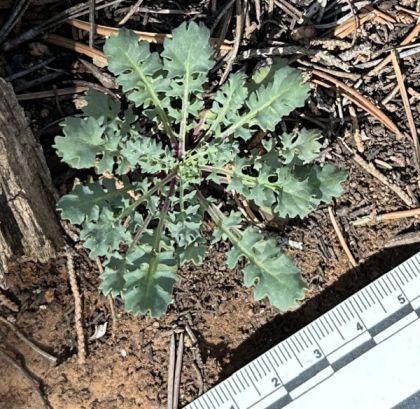
Rosette width 65 mm; terminal lobe width of 9.7 to 10.8 mm. Plant #19 from the area along the Rim Trail north of the Old Visitor Center, now the Park Headquarters. | |

Rosette width 71 mm; terminal leaf lobe widths 11.7 to 15.4 mm. Plant #7 from the area along the Rim Trail north of the Old Visitor Center, now the Park Headquarters. | |

Rosette width of 78 mm; terminal leaf lobe widths of 11.2 to 15.7 mm. Plant #4(bottom) from the Rim Trail west of Yavapai Point. | |

Rosette width 82 mm; terminal leaf lobe widths 8.0 to 10.9 mm. Plant #6 from the area along the Rim Trail north of the Old Visitor Center, now the Park Headquarters. | |

The lower plant is the one measured. Rosette width of 83 mm; terminal lobe width from 13.1 to 18.8 mm. Plant #20 from the Grandview Trail, that may be the same plant seen 1.8 years earlier. This was the largest plant that still had the young leaves with a larger terminal lobe, perhaps because it was the only plant growing in the Canyon and not on the Rim, and/or because there are two plants growing in nearly the same spot. | |

Rosette width 89 mm; terminal leaf lobe widths 8.4 to 13.4 mm Plant #2 from the Rim Trail west of Yavapai Point. | |

Rosette width 91 mm; terminal leaf lobe widths 10.5 to 11.3 mm. Plant #3 from the Rim Trail west of Yavapai Point. | |

Rosette width 108 mm; terminal leaf lobe widths 9.9 to 14.0 mm. Plant #16 from the area along the Rim Trail north of the Old Visitor Center, now the Park Headquarters. This plant had the largest rosette of any non-blooming plant. | |

Rosette width of 122 mm, but that is based on somewhat dried leaves which were probably somewhat longer before they dried. This has the largest rosette of any plant I measured. The terminal leaf lobes were too withered to measure.
Plant #23, the only Packera plant I found in my Zuni Point survey. | |
| Fig. 3. Photos of all the P. multilobata plants with a ruler in the photo. Measurements of the rosette width and terminal lobe widths are given for each plant.
Click on the pictures to go to the iNat obs. | |