Plant Guide to Ed Hastey Desert Garden Trail, Santa Rosa Mountains Visitor Center This is a working list, about which I make no guarantees at all until I officially release it. Use at your own risk!
Introduction and Explanation of Plant Trail Guides
Introduction
Highlights of This Trail
Fieldwork Dates and Summary of List Changes With Time
Botanical Trip Reports
The Plant Guide
Comments On Specific Species
Introduction The Ed Hastey Desert Garden Trail is located at the Visitor Center for the Santa Rosa and San Jacinto Mountains National Monument. The Visitor Center is four miles uphill from the bottom of SR74.
The Hastey Trail primarily contains plants typical of the local area, which is alluvial plain and desert wash. It also contains a small number of plants transplanted from other locations within the Monument.
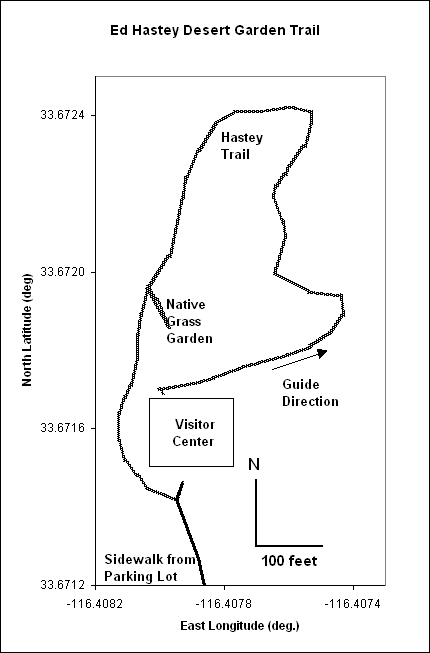
The trail is 0.19 miles long (0.30 km), and loops from the back of the Visitor Center to its front. The trail can be done in either direction, but this guide is for the counterclockwise route beginning behind the Visitor Center (see map).
The trail is well signed for plants; it has 41 signs labeling 25 different species. Thus a bit over half of the 47 species on the trail are identified with signs. Four species have three labeled specimens; eight species have two labeled specimens; and 13 species have a single labeled specimen.
The trail is named for Ed Hastey, former director of the California office of the Bureau of Land Management for 20 years, who was instrumental in establishing the Monument. Hastey was a leader in promoting ecosystem-based conservation strategies.
Highlights of This Trail Some of the botanical highlights of this trail are:
Number of Unique Taxa On This Trail
The following histogram gives the number of trails in my database that contain each taxon on this trail. I had 101 trails in our database when this histogram was made; 2 of those trails, including this one, are in this area of Santa Rosa Mountain. A number of "1" means the taxon has only been found on this trail among the trails in my database; numbers of "2" or smaller may indicate taxa found only in this area of Santa Rosa Mountains.
Number of Trails
Containing A TaxonNumber Of Taxa
On This Trail% of Taxa
On This Trail1 7 15% 2 1 2% 3 5 11% 4 3 6% 5 1 2% 1-5 17 36% 6-10 17 36% 11-15 6 13% 16-20 1 2% 21-25 2 4% 26-30 4 9% Total Taxa 47 100% I found 0 additional species not in the above table, since they have not been fully identified yet. The unidentified ones are marked with ? or sp in the id? column in the guide, and have no entries in the #all column.
The taxa unique to this trail in my plant trail guides, as of 2/17/07, are:
Scientific Name Common Name Baileya multiradiata var. multiradiata *desert marigold Ambrosia deltoidea *triangle leaf bursage Opuntia echinocarpa silver cholla Opuntia parryi cane cholla Prosopis pubescens screw-bean mesquite Senna covesii Coves's cassia Asclepias subulata ajamete
Fieldwork Dates and Summary of List Changes With Time The following table gives the dates the trail was walked and taxa recorded. After each visit, the table gives the total number of taxa on the list and the breakdown of the taxa without positive identification. See Explanation of Plant Trail Guides to understand the symbols below.
Visit Date Visit # # taxa # "?" # "sp" # "~" # "ssp" 2/14/2007 1 46 1 2 7 0 2/17/2007 2 47 0 2 4 0 The numbers above do not include the three specimens planted from one-gallon pots that were on the trail only during the week of 2/17/07.
Botanical Trip Reports
The Plant Guide The mileages in the guide are from a GPS of the trail.
If a sign is present for a given species, "Sign: " appears before the common name. The first occurrence of each species is noted in the guide with all columns filled in; subsequent occurrences are only noted if there is a sign. In those cases, only the names are given without the other column information.
Names on the sign occasionally differ from those in my database. If so, if it is the first occurrence on the trail, the name on the sign is given in parentheses with my names. Subsequent occurrences give just the name on the sign.
Taxa not native to the Monument are indicated with an asterisk before the common name.
Version for printing, without lines and other text on this page: html (4 pages) or pdf Clickbook booklet (1 double-sided page). (See printing instructions for an explanation of these options)
Mile S # id? (Sign) Common Name Latin Name #here #all 0.00 Begin trail at back of Visitor Center, at west end of patio. 0.00 l 1 Sign: desert-willow Chilopsis linearis ssp. arcuata 3 / 3 7 0.00 l 2 desert tobacco Nicotiana obtusifolia 4 / 2 4 0.00 Switchback right 0.00 l (sweetbush, Bebbia juncea var. aspera) 0.00 l 3 smoke tree Psorothamnus spinosus 3 / 3 6 0.00 l 4 ~ desert baccharis Baccharis sergiloides 5 / 2 6 0.00 l (cheesebush, Hymenoclea salsola var. salsola; desert lavender, Hyptis emoryi) 0.00 l Sign: "Ed Hastey Trail [ahead]" 0.00 l 5 Sign: California (desert) fan palm Washingtonia filifera 2 / 2 6 0.00 l 6 *desert marigold Baileya multiradiata var. multiradiata 10 / 2 1 0.00 l 7 chuparosa Justicia californica 20 / 9 8 0.01 r 8 Bigelow's desert four-o'clock Mirabilis bigelovii var. bigelovii 1 / 1 3 0.01 l 9 Sign: catclaw Acacia greggii 2 / 2 10 0.01 l 10 burroweed Ambrosia dumosa 1 / 1 11 0.01 r 11 Sign: sacred datura (Jimson weed on sign) Datura wrightii (=D. meteloides) 1 / 1 21 0.01 r 12 Sign: Mojave (old man) prickly-pear Opuntia erinacea var. erinacea 3 / 2 3 0.01 l 13 brittlebush Encelia farinosa 20 / 9 12 0.01 l 14 creosote bush Larrea tridentata 3 / 3 9 0.01 r 15 jojoba Simmondsia chinensis 5 / 5 7 0.01 r 16 beavertail cactus Opuntia basilaris var. basilaris 4 / 3 14 0.01 l Sign: "old man prickly pear, Opuntia erinacea" 0.01 r 17 cheesebush Hymenoclea salsola var. salsola 20 / 9 9 0.01 l 18 Sign: desert lavender Hyptis emoryi 10 / 9 8 0.01 r Sign: "jojoba, Simmondsia chinensis" 0.01 l 19 ~ small-seeded spurge Chamaesyce polycarpa 40 / 9 19 0.01 r 20 *triangle leaf bursage Ambrosia deltoidea 1 / 1 1 0.01 l Sign: "desert fan palm, Washingtonia filifera" 0.01 l 21 sweetbush Bebbia juncea var. aspera 10 / 9 15 0.01 r (*Cleveland sage, Salvia clevelandii) 0.01 r Sign: "beavertail cactus, Opuntia basilaris" 0.02 l Sign: "creosote bush, Larrea tridentata" 0.02 r Sign: "jojoba, Simmondsia chinensis" 0.02 l Sign: "chuparosa, Justicia californica" 0.02 l Sign: "creosote bush, Larrea tridentata" 0.02 r 22 Sign: bladderpod Isomeris arborea 1 / 1 10 0.03 l 23 Sign: indigo bush Psorothamnus schottii (=Dalea schottii) 1 / 1 10 0.03 l 24 bearded cryptantha Cryptantha barbigera 1 / 1 3 0.03 r (Sign: "cheesebush, Hymenoclea salsola") 0.03 r 25 desert needle Palafoxia arida var. arida 20 / 9 4 0.03 r 26 Sign: Thurber's sandpaper-plant Petalonyx thurberi ssp. thurberi 10 / 9 3 0.03 r Sign: "desert lavender, Hyptis emoryi" 0.04 Trail turns left 90° 0.04 r "Coyote" bench 0.04 l Sign: "desert lavender, Hyptis emoryi" 0.05 l 27 wire-lettuce Stephanomeria pauciflora var. pauciflora 1 / 1 12 0.05 l (Gander's cholla, Opuntia ganderi) 0.05 Trail turns right 90° 0.05 b Lots of small-seeded spurge, Chamaesyce polycarpa 0.06 r 28 pencil cholla Opuntia ramosissima 2 / 2 5 0.06 l (world's largest, shrubbiest, oldest desert trumpet, Eriogonum inflatum) 0.06 l Sign: "chuparosa, Justicia californica" 0.06 r Sign: "sandpaper-plant, Petalonyx thurberi" 0.07 r Sign: "desert-willow, Chilopsis linearis" 0.07 l Sign: "beavertail cactus, Opuntia basilaris" 0.07 r (silver cholla, Opuntia echinocarpa) 0.08 r 29 desert trumpet Eriogonum inflatum 1 / 1 6 0.08 Switchback left 0.08 l Sign: "brittlebush, Encelia farinosa" 0.09 r 30 silver cholla Opuntia echinocarpa 1 / 1 1 0.09 r 31 Sign: blue palo verde Cercidium floridum ssp. floridum 3 / 3 3 0.10 r Sign: "smoke tree, Psorothamnus spinosus" 0.12 r ~ (*elm, Ulmus sp.) 0.12 r 32 Sign: honey mesquite Prosopis glandulosa var. torreyana 1 / 1 7 0.13 l Jct. side trail; Sign: "Native grass garden ..."; go left on it 0.13 b 33 deergrass Muhlenbergia rigens 10 / 1 26 0.13 r 34 Mexican rush Juncus mexicanus 4 / 1 21 0.14 Sign ahead: "deergrass, Muhlenbergia rigens" 0.14 (ahead: desert mistletoe, Phoradendron californicum; desert star-vine, Brandegea bigelovii) 0.14 r Sign: "Mexican rush, Juncus mexicanus" 0.14 Turn around and rejoin main trail 0.15 r Sign: "sandpaper-plant, Petalonyx thurberi" 0.15 l 35 chia Salvia columbariae 5 / 1 26 0.15 l 36 ~ desert prickly-pear Opuntia phaeacantha 1 / 1 4 0.16 l 37 cane cholla Opuntia parryi 2 / 1 1 0.16 r Sign: "blue palo verde, Cercidium floridum" 0.16 l (Engelmann's hedgehog cactus, Echinocereus engelmannii) 0.16 r 38 desert star-vine Brandegea bigelovii 1 / 1 2 0.16 r 39 sp Sign: Vasey's prickly-pear Opuntia vaseyi (=O. littoralis var. vaseyi) 1 / 1 27 0.17 r 40 Sign: teddy-bear cholla Opuntia bigelovii 1 / 1 7 0.17 l 41 Mohave yucca Yucca schidigera 1 / 1 11 0.17 l 42 Sign: California barrel cactus Ferocactus cylindraceus (=Ferocactus acanthodes) 2 / 1 8 0.17 l 43 sugar bush Rhus ovata 1 / 1 29 0.18 l 44 screw-bean mesquite Prosopis pubescens 1 / 1 1 0.18 r Sign: "chuparosa, Justicia californica" 0.18 r Sign: "smoke tree, Psorothamnus spinosus" 0.18 l 45 California trixis Trixis californica var. californica 1 / 1 8 0.18 l (Sign: "catclaw acacia, Acacia greggii") 0.18 r Sign: "blue palo verde, Cercidium floridum" 0.19 l (white sage, Salvia apiana) 0.19 l (ocotillo, Fouquieria splendens ssp. splendens) 0.19 l Sign: "Ed Hastey Desert Garden Trail ..." 0.19 Trail turns left to Visitor Center entrance 0.19 l sp (Sign: "penstemon, Penstemon sp.") 0.19 l 46 Coves's cassia Senna covesii 1 / 1 1 0.19 l (California buckwheat, Eriogonum fasciculatum) 0.19 l (*Cooper's paper-daisy, Psilostrophe cooperi) 0.19 End Desert Garden Trail. Just ahead, the last plant before entering the visitor center, is the yellow-flowered form of chuparosa, Justicia californica. To see the next species, turn around and head to the parking lot; it is on the sidewalk continuation just after you cross the circular driveway 0.20 l 47 ajamete Asclepias subulata 1 / 1 1 To see the next species, continue to the end of the parking lot; it is in the island there (apricot mallow, Sphaeralcea ambigua var. ambigua) The final species is on the east side of the Visitor's Center, east of the Cleveland sage (arrow-weed, Pluchea sericea) The following species were on the trail only during the weekend of 2/17/07: 0.19 l (*Salvia X trident: S. mojavensis X S. clevelandii X S. dorrii) 0.19 l *Lady in Red Salvia coccinea 2 / 1 0.19 l *Bush Germander Teucrium fruticans 'azureum' 1 / 1
Comments On Specific Species (none)
I thank:
- Jane Strong for help with identifications for several species and for excellent comments on the Guide;
- Bonnie Adkins for providing the identifications of the last three planted non-native specimens in the guide, and for her help when I was doing the fieldwork for this plant guide;
- two anonymous people with help in resolving the determination for the world's largest Eriogonum inflatum, despite its appearance as a completely different shrub-like form; and
- Andy Sanders for determining that the Petalonyx species on this trail was actually P. thurberi, despite having linear non-clasping leaves that appeared to indicate a determination of P. linearis, and confirming my determination of Ambrosia deltoidea.
Go to:
Copyright © 2007 by Tom Chester.
Permission is freely granted to reproduce any or all of this page as long as credit is given to me at this source:
http://tchester.org/sb/plants/guides/visitor_center.html
Comments and feedback: Tom Chester
Updated 22 February 2007.