Plants of Southern California: Mentzelia albicaulis and M. montana
Table of Contents
Introduction and Flower Bracts
Fruit Size Difference
Distribution Maps and Elevations
Photos of Flower and Inflorescence Bracts
Introduction and Flower Bracts
Mentzelia albicaulis and M. montana are two very similar species. The Flora of North America treatment summarized the differences well:
Mentzelia montana is widely distributed and, in portions of its range, difficult to distinguish from M. albicaulis. Mentzelia montana is morphologically intermediate to M. albicaulis and M. congesta, but ecologically more similar to M. congesta (J. M. Brokaw 2009). Mentzelia montana generally occurs at higher elevations than M. albicaulis and is best distinguished morphologically from M. albicaulis by capsule and bract characteristics. Capsules of M. montana are usually not longer than 17 millimeters or curved more than 45°, whereas those of M. albicaulis are often longer and more curved. Both species may have bracts with some lobes and whitish base, but only M. montana has populations in which these features are prominent. Sepal and petal lengths, which have sometimes been used to distinguish these species, overlap completely.
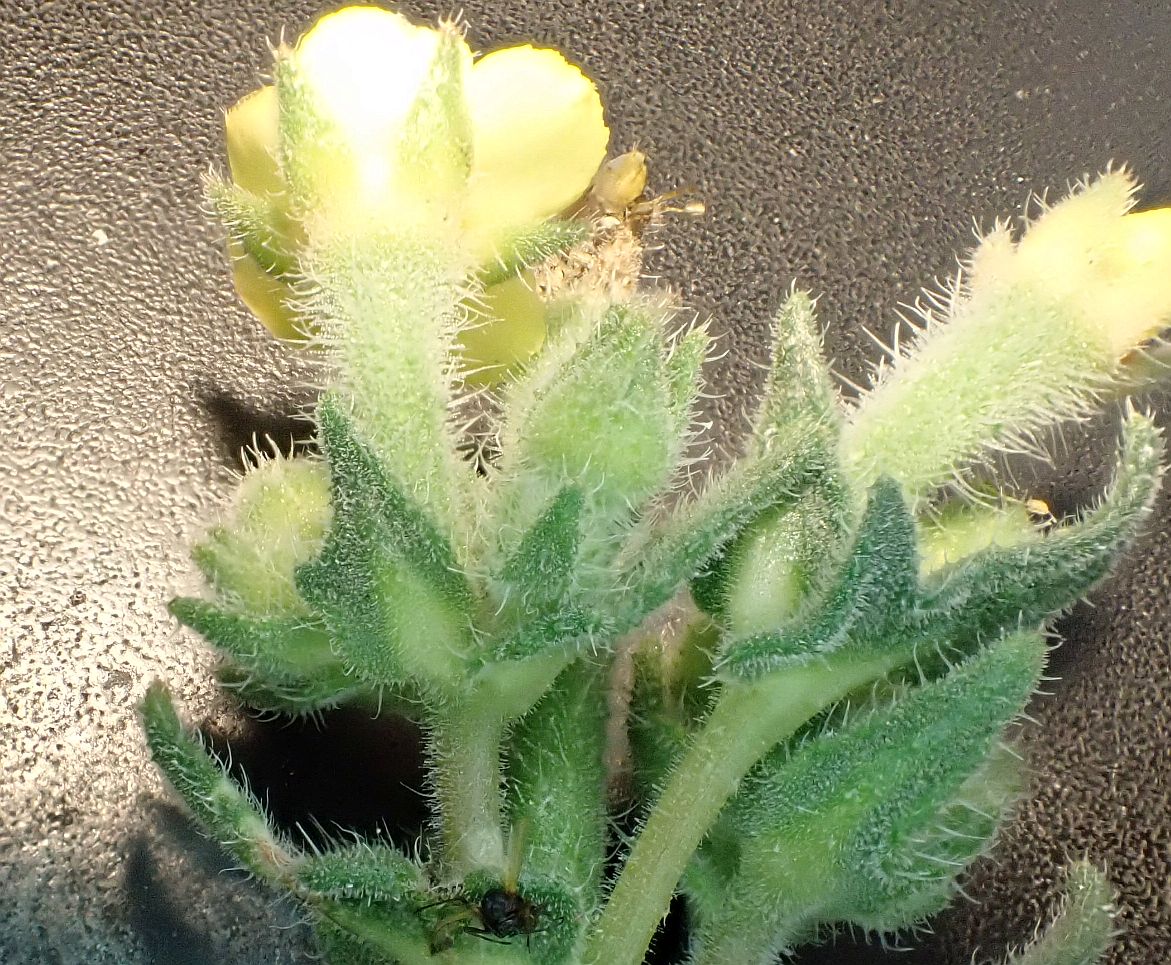
The flower bract is the single leaf-like bract immediately below every flower / fruit except for the special case when the first flower / fruit forms between two branches of an inflorescence stem, and there are only inflorescence bracts (~leaves) at the base of each stem. In all other cases, the flower / ovary / fruit emerges from the base of a flower bract. Fig. 1 shows some examples of the flower bracts for each species.
Important note: Care must be taken to distinguish an inflorescence bract (~leaf) in the inflorescence from a flower bract! Fig. 2 shows the difference.
Mentzelia albicaulis | M. montana |
| 
|

| 
|
| Fig. 1. Flower Bracts of Mentzelia albicaulis (left) and M. montana (right).
Flower bracts of M. montana normally have 3 to 7 prominent lobes, and a small but distinct white area at their base, as shown in the two pix on the right. The flower bract of M. albicaulis is variable. It often has no white area at base, only the different color of the midvein, as shown in the photo at lower left. But it can have a small white area near the base that is similar to that of M. montana, as shown in the photo at upper left. The flower bract at upper left was the one with the most prominent white spot out of ~25 photos of flower bracts from five different plants at Whale Peak. See the photos below of flower bracts from the five different plants, showing how rare it is to see such a white base for M. albicaulis The flower bract of M. albicaulis is often narrowly lanceolate and either entire or weakly three lobed. The flower bract of M. montana is usually wider, with 3 to 7 prominent lobes. The two upper photos show only a single weak side lobe for the bract of M. albicaulis, compared to four side lobes for the bract of M. montana, of which the upper two are prominent. Photos by Tom Chester. The top photo of Mentzelia albicaulis is from the northwest base of Whale Peak at an elevation of about 4400 feet. The bottom photo is from Canyon 41 of Anza Borrego Desert State Park at an elevation of about 1200 feet. The top photo of Mentzelia montana is from Lily Spring in the San Gabriel Mountains at an elevation of about 7000 feet. The bottom photo is from the PCT above the Cedar Spring Trail on the Desert Divide at San Jacinto Mountain at an elevation of about 6800 feet. Click on the pictures for larger versions. | |
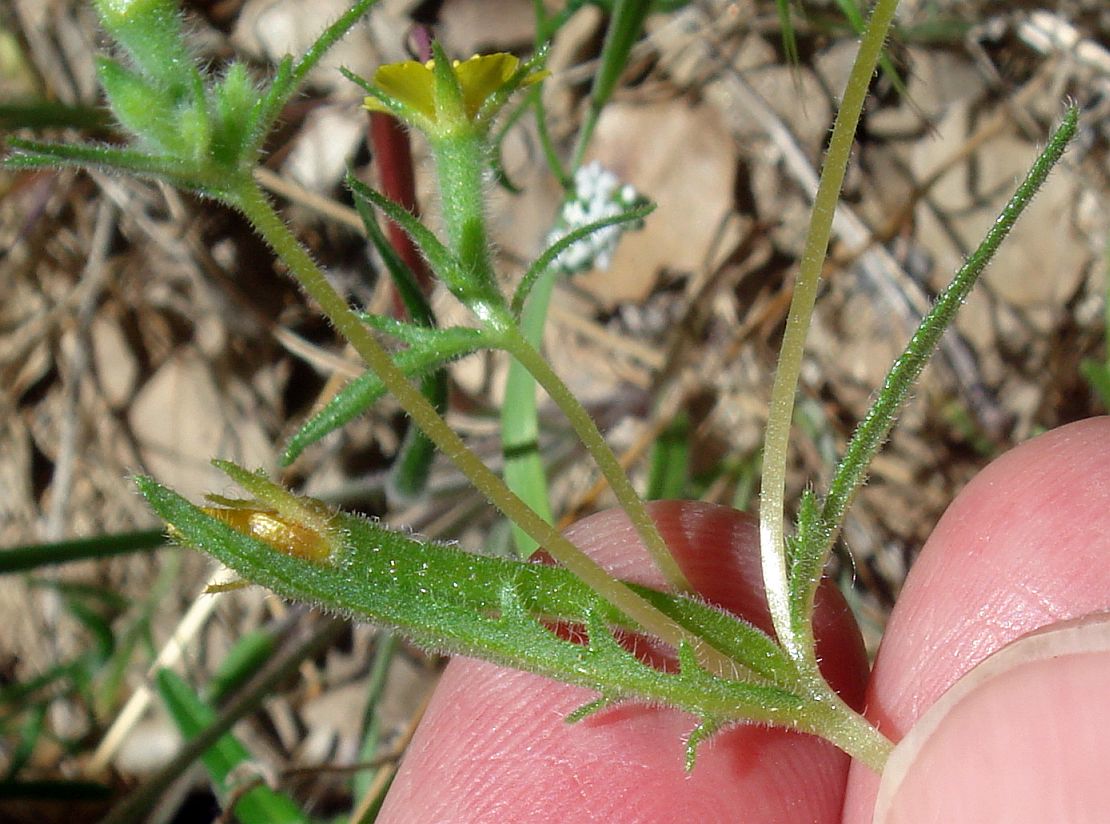
Fig. 2. Photo showing the difference between inflorescence bracts and flower bracts, and the "special case" of the first flower / fruit. The lowermost fruit in this pix is a "special" fruit because it has no flower bracts, and because it can curve up to 45° at maturity for M. montana, and up to a full 180° at maturity for M. albicaulis. See photo of a 180° curved fruit of M. albicaulis from Canyon 41.
It is sometimes difficult to figure out which is the flower bract when the flowers are crowded, since there are also inflorescence bracts present as well, as in the out of focus crowded buds at extreme upper left. Many times I and others have photographed what turns out to be an inflorescence bract, and not the actual flower bract. See examples in Fig. 4.
Fruit Size Difference
This is a collection of some measurements I've made in different places.
M. albicaulis. From the Whale Peak area on 15 March 2026: 22 mm (location #3); 20 mm (location #4); and 21 mm (location #5).
From Glorietta Canyon on 23 March 2009: 19 mm.
All of these are clearly more than 17 mm.
M. montana. From the PCT north of Cedar Spring Trail: 15 mm (location #1). This fits the "usually not longer than 17 mm".
Distribution Maps and Elevations
I used the CCH2 Geographic Search site to download the vouchers of each of these two species on 19 March 2026. The search box was for southern California for the Transverse Range and south (San Gabriel and San Bernadino Mountains), and east of longitude -118.8, roughly the Thousand Oaks / Simi Valley area.
The download contained 260 vouchers of M. albicaulis and 157 vouchers of M. montana. I used the USGS National Map Bulk Point Query Service to obtain elevations for each voucher.
Figs. 3, 4 and 5 show, for all the vouchers and for each species, the map of the locations; a plot of elevation vs. longitude; and a histogram of the elevations. I did no review of the vouchers at all prior to making these maps.
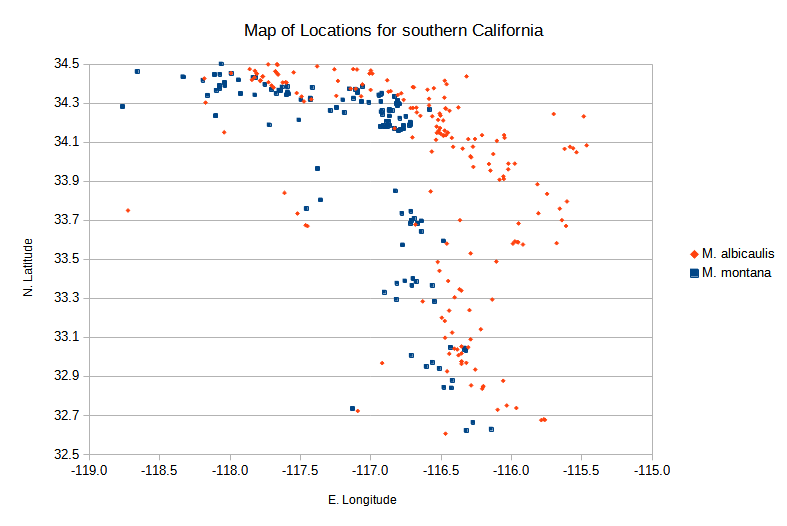
Fig. 3. Map for vouchers of M. albicaulis and M. montana for southern California.

Fig. 4. Plot of elevation vs. longitude for vouchers of M. albicaulis and M. montana for southern California.

Fig. 5. Histogram of elevations for vouchers of M. albicaulis and M. montana for southern California.
As stated by the floras, M. albicaulis is mostly a "lower elevation desert slopes" species, whereas M. montana is found at higher elevations in the mountains above the desert slopes. M. albicaulis is mostly found below 4500 feet elevation, and M. montana is mostly found from 3500 to 7000 feet.
For comparison, for M. albicaulis, Munz 1974 gives "desert slopes between 1500 and 5500 feet", and the Flora of North America gives 0 to 2300 m (7550 feet).
For M. montana, Munz 1974 gives "on talus slopes and open areas in montane forests betwen 4500 and 6000 feet", and the Flora of North America gives 600 to 3400 m (2000 to 11,200 feet).
The Munz elevation ranges for both species are clearly a bit narrower than the actual distribution.
These plots also show that some vouchers are highly likely to be misdetermined, or have inaccurate georeferenced positions. Some vouchers of M. albicaulis are located above 6000 feet elevation in the midst of large numbers of M. montana, and some vouchers determined as M. montana are found at suspiciously low elevations in the midst of large numbers of M. albicaulis. This is not surprising at all, given the difficulties of properly determining some specimens, and accurately georeferencing sometimes-vague locations.
The following figures 6, 7 and 8 zoom in on the vouchers from the San Jacinto Mountains, the Peninsular Range, and Anza Borrego Desert State Park, which avoids combining the higher-elevation Mojave Desert and the lower-elevation Sonoran Desert. I will just call this area the PR for short.

| 
|
| Fig. 6. Map for vouchers of M. albicaulis and M. montana for PR. Left: plot with all the vouchers. Right: Image from Google Earth, to show the locations of the vouchers on a map. Four problematic vouchers, explicitly given below, have been deleted from the Google Earth map. | |

Fig. 7. Plot of elevation vs. longitude for vouchers of M. albicaulis and M. montana for PR.

Fig. 8. Histogram of elevations for vouchers of M. albicaulis and M. montana for PR.
These plots show a cleaner elevation histogram for both species, with M. albicaulis found almost uniformly between 500 and 4000 feet elevation, and M. montana with a fairly sharp distributiom from 3000 to 5500 feet.
The voucher for "M. albicaulis" at 5674 feet elevation stands out as unusual in all three plots. It is from the summit of Garnet Peak, SD507157, at (32.92561, -116.45807) (lat, lon), and its determination should be checked.
The voucher for "M. albicaulis" from the Hurkey Creek Campground in Garner Valley at San Jacinto Mountain also stands out in the map of locations, being a single voucher determined as that species amidst ~eight vouchers of M. montana. It is LA17574, from (33.67749, -116.68310), at 4437 feet elevation.
The voucher for "M. montana" at 2540 feet, in the middle of many vouchers of M. albicaulis, also stands out. This voucher is SD507257, with a duplicate at BSCA3584006, from Cool Canyon.
There are possibly other vouchers that should be re-checked, but none of them stand out as clearly as the three listed just above. In particular, the westernmost voucher determined as M. albicaulis, plotted at Warner Springs at (33.2842, -116.63113), and west of a voucher of M. montana, is a 1925 voucher from Jaeger which has a very uncertain location. ("Warner Springs" may just have been the closest named location.) Even if the location is actually at Warner Springs, that is a lower elevation location than the vouchers of M. montana to the east, so that voucher may well be correctly determined and georeferenced.
Photos of Flower and Inflorescence Bracts
Fig. 9 shows two pictures of the flower bract for M. montana. Fig. 10 shows a number of pictures of the flower bract and inflorescence bracts for M. albicaulis, as well as one pix showing the "special" fruit curved 180° that doesn't have a flower bract. These were originally the only pix shown on this page, and were taken before I was aware of how easy it was to confuse the flower bract with an inflorescence bract. I've labeled the pix by what I think is shown in each photo.

|
|
| Fig. 9. Pictures of the flower bract for M. montana from Lily Spring Area, San Gabriel Mountains, near 8000 feet elevation | |
Pictures of the flower bract and/or inflorescence bracts of M. albicaulis
| From "Canyon 41", the canyon just south of Moonlight Canyon in Agua Caliente County Park, Tierra Blanca Mountains, near 1400 feet elevation | ||
|---|---|---|
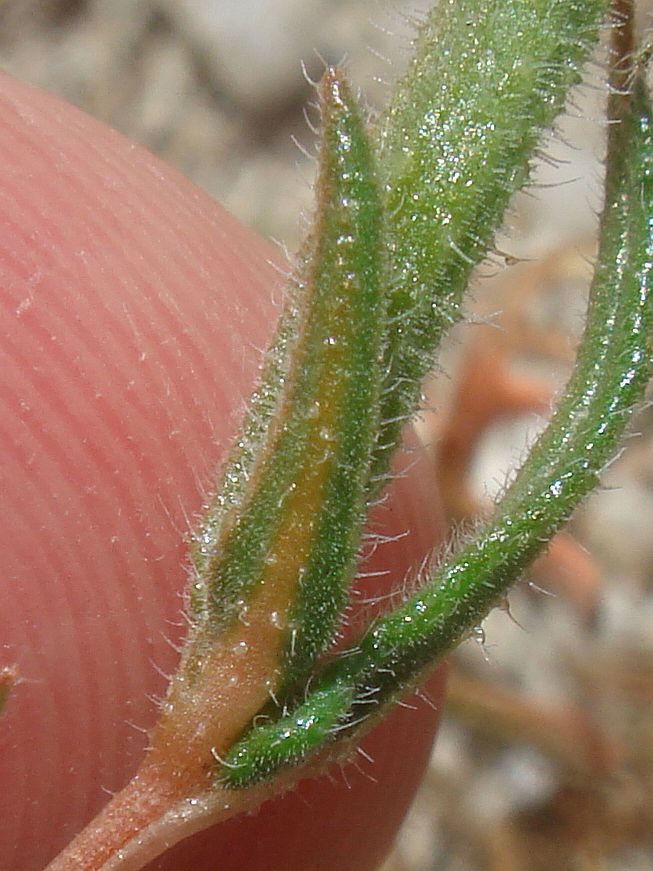
Flower bract | 
Flower bract | 
Probably the flower bract |
|
Flower bract | 
Flower bract | 
Flower bract |

No flower bract present since this is a stem branch with the first flower/fruit on the plant. | ||
| From Glorietta Canyon, just southwest of Borrego Springs, near 1400 feet elevation | ||

| 
| (Intentionally blank) |
| Neither of these are probably flower bracts, since they are not clearly the closest bract to the base of the fruit. | ||
| From the Whale Peak Trail, Vallecito Mountains, north of Agua Caliente County Park, from five separate locations along the trail, from 4200 feet elevation to 5300 feet elevation. | ||
| Location 1, at 4200 feet elevation, near the Schad Trailhead | ||

Probably flower bract | 
Probably flower bract | (Intentionally blank) |
| Location 2, at 4250 feet elevation. | ||

Unclear whether this is a flower bract or not | 
Unclear whether this is a flower bract or not | (Intentionally blank) |
| Location 3, at ~4320 feet elevation. | ||
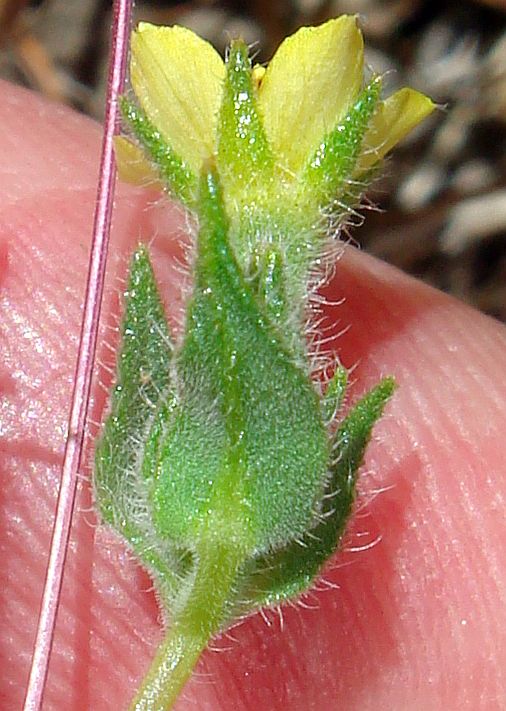
Unclear whether this is a flower bract or not | 
Unclear whether this is a flower bract or not | (Intentionally blank) |
| Location 4, at ~4550 feet elevation | ||
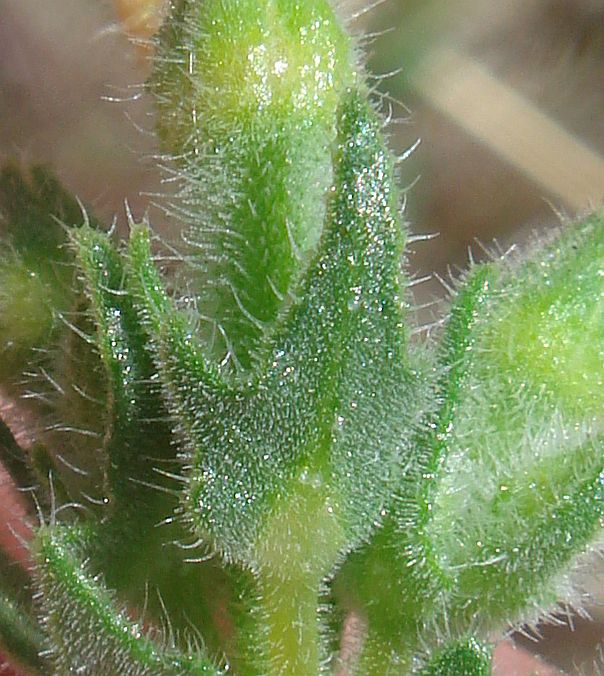
Unclear whether this is a flower bract or not | 
Unclear whether this is a flower bract or not | 
Unclear whether this is a flower bract or not |

Flower bract | 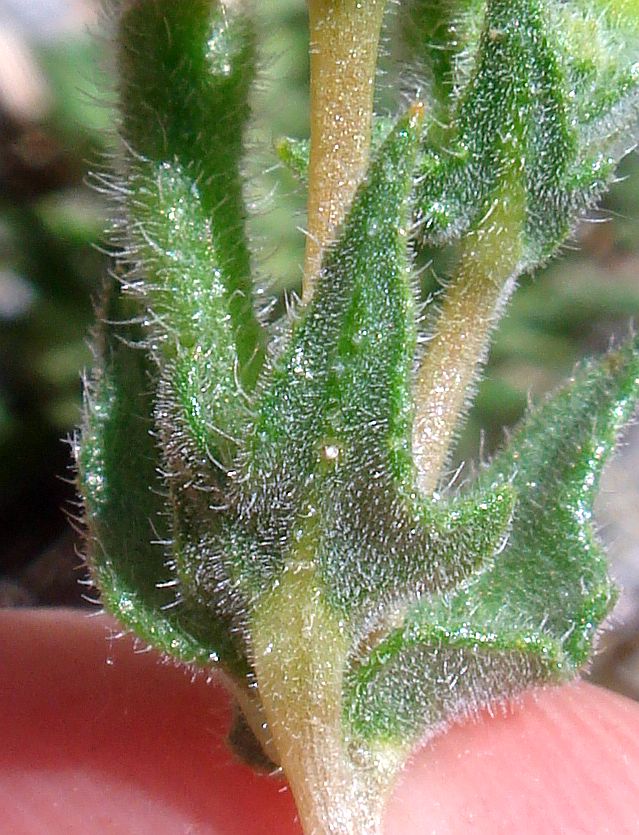
Unclear whether this is a flower bract or not | 
Unclear whether this is a flower bract or not |
| Location 5, at 4800 feet elevation | ||

Flower bract | 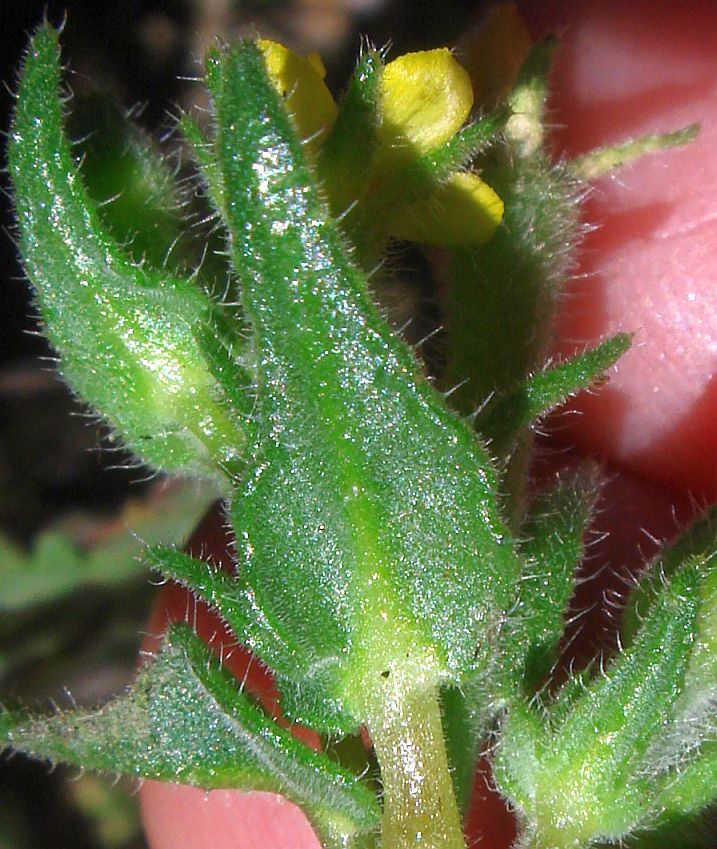
Unclear whether this is a flower bract or not | 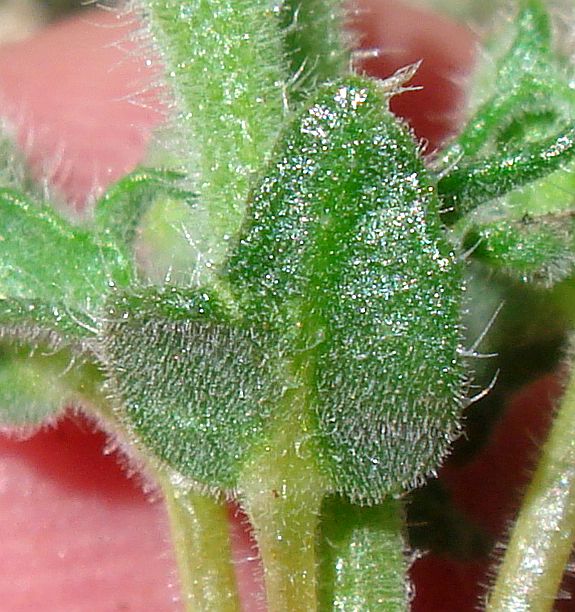
Unclear whether this is a flower bract or not |
| Fig. 10. Pictures of the flower bract and/or inflorescence bracts of M. albicaulis, as well as one pix showing the "special" fruit curved 180° that doesn't have a flower bract. | ||