Psathyrotes ramosissima, turtleback
|
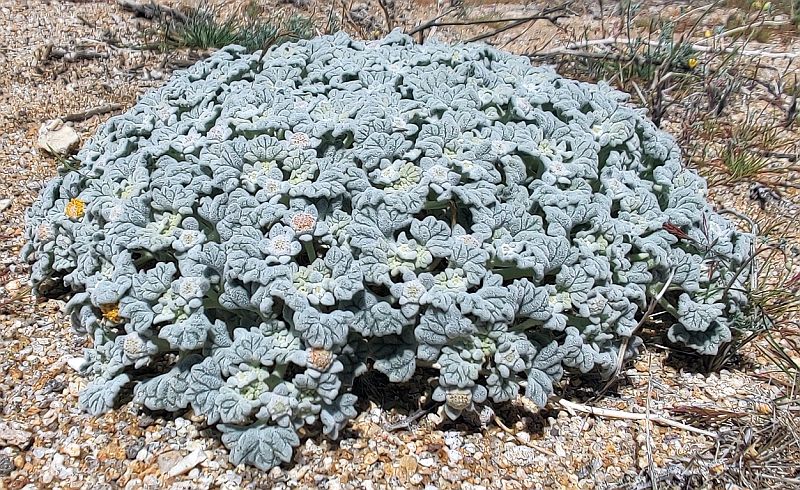
| Fig. 1. A beautiful side view of a turtleback plant that looks so much like a turtle shell that you might expect a turtle's head to peek out from it at any time. Photo by Fred Melgert and Carla Hoegen taken in a canyon south of Sweeney Pass on 23 March 2023. Click on the photo to go to their original iNat observation. |
Introduction
Psathyrotes ramosissima, turtleback, is one of the favorite species for many botanists. It forms cute little mounds that indeed resemble the shape of a turtle's shell. Its leaves are richly patterned from its veins, and have a striking bright blue-gray color. Its small flowers peek out from between the leaves. Simply put: it is a charming plant!
But in fall 2026, I realized I hadn't seen it since spring 2023, and was wondering why. On 21 November 2026, Karyn Sauber reported that she had at least 12 turtlebacks blooming in her Canebrake yard. Silke Gathmann, Don Rideout, Karyn Sauber, Mark Stevens and I were hiking June Wash, essentially across the highway from Canebrake, the next day, so we decided to follow-up observations I and others had made there from previous years.
There were 13 iNat observations of turtleback from six different locations spread over about a half mile near the junction of S2 and June Wash. Twelve of those observations were from four years prior, 12/23/2022 to 3/25/2023, with the 13th obs from 11/28/25.
We completely struck out for live plants, which surprised me greatly. Worse, there were no dead plant remnants at any of those locations. The only turtlebacks found on our hike that day were two dead plants found by Don at a location perhaps 100 feet from one of the previous locations.
How could it be that Karyn had happy blooming plants in her yard, but we couldn't find any here?
The next day, I analyzed iNat posts of this species for the last nine complete desert seasons, defined as July 1 of one year to June 30 of the next year, and found that turtleback observations peaked strongly in 2022-2023; see Fig. 2.
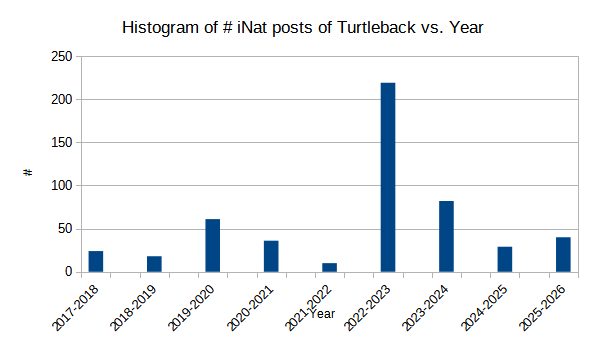
Fig. 2. Histogram of the number of iNat posts of turtleback for nine complete desert seasons (July 1 of one year to June 30 of the next year). Note the strong peak from July 1, 2022 to June 30, 2023.
To interpret this histogram, I need to compare it to the histogram of all iNat observations for the Borrego Desert, shown in Fig. 3:
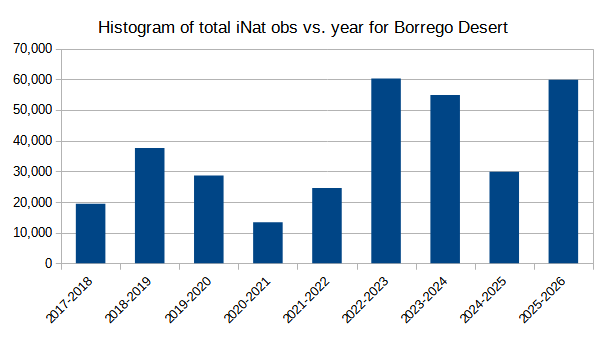
Fig. 3. Histogram of the number of all iNat posts of plants for nine complete desert seasons (July 1 of one year to June 30 of the next year). The number of plant observations posted at iNat has been roughly constant since 2022-2023, except for the drought year of 2024-2025 when there were essentially no annuals present on the desert floor.
The number of iNat obs in the Borrego Desert has been essentially constant in three desert years, 2022-2023, 2023-2024, and 2026-2026, but the number of turtleback obs dropped to just 37% of the 2022-2023 numbers in 2023-2024, and to just 18% in 2025-2026.
So clearly 2022-2023 was a banner year for turtleback to appear, and it has never been as abundant since then. This agrees with my experience of not seeing this species since 2022-2023.
2022-2023 had abundant monsoonal rainfall, capped off by Tropical Storm Kay dumping four inches of rain on the desert side of the mountains. This was much more rainfall than in subsequent years.
So now I had my answer: turtleback needs LOTS of summer / fall rainfall to be abundant. Although it is not strictly speaking a monsoonal annual, since it doesn't complete its life cycle in the summer / fall, it strongly germinates in response to good monsoonal rain.
The Jepson eFlora gives its habit as an "annual or perennial herb". It probably survives from year to year only when there continues to be good monsoonal and winter/spring rains after its first year.
As to why Karyn still had live blooming turtleback plants in her yard, whereas we found none in June Wash, it is almost surely related to the 0.44 inches of monsoonal rain that essentially only Canebrake got on August 11, 2026, which was followed by another 1.47 inches of more widespread rain on 10-12 October 2026. Canebrake tends to get monsoonal rain on a more regular basis than other nearby places. The Mammillaria tetrancistra bloomed in August 2026 in Canebrake from that rain, but not in nearby areas.
It is possible that the blooming plants in Karyn's yard might be survivors from 2023. She also has a number of dead turtlebacks in her yard.